Sunday, December 18, 2011

The Story of Alakitja

Alakitja was a large rock cod, a fish who lived in the water of the River, the Milky Way. He swam to reach his favourite water hole. He swam carefully past the fishtraps placed there by the Sky People. He swam past the many water lilies with their white flowers shining so brightly that people could se them, and they called them stars. Finally he reached a water hole, where he rested under a rock way from the hot Sun.


The Two Brothers were hungry. They had been busy making mountains and rivers on Earth and they now looked for food. They crept up to the water hole and saw the gigantic fish Alakitja. They drove their spears into Alakitja and pulled the fish from the water hole.

They shared the fish and each brother made his own campfire. They can still be seen there today. The two campfires are the stars Delta Crucis and Gamma Crucis. The two brightest stars of the cross, Alpha and Beta Crucis, are the Two Brothers. The fish is the dark patch close by (the Coal Sack).
The two pointers, Alpha and Beta Centauri, are friends of the brothers who are waiting for their share of Alakitja the fish.
The Southern Cross (Right), the Coal Sack (Middle), and the Pointers (Left)
 - all in the Milky Way.
Source: Questacon.

Sunday, December 11, 2011

Aboriginal Astronomy Lecture at Lake Tyrrell

Below is a 4-part video of the Lake Tyrrell lecture on Aboriginal Astronomy by Paul Curnow (BEd), a Lecturer at Adelaide Planetarium.  His talk places a focus on the astronomy of the local Boorong (Wergaia) people.

The video is a bit dark, but the audio is clear and Paul does a great job at explaining the Western and Aboriginal aspects of the night sky.  Enjoy!


Wednesday, November 30, 2011

Keynote Lecture on Aboriginal Astronomy

A 45 minute video on Aboriginal Astronomy by keynote speaker Professor Ray Norris is available from the Australian Science Teachers Association website.  Click on the image below for the video.

Professor Ray Norris giving a lecture on Aboriginal Astronomy.
 Click on this image to go to the video.

Ray Norris is an astrophysicist at the CSIRO Astronomy & Space Science. He received an Honours Degree in Theoretical Physics at Cambridge University and then a PhD at Manchester University. He moved to Australia in 1983 to work for CSIRO Australia Telescope National Facility, where he became Head of Astrophysics in 1994 and Deputy Director in 2000.  He currently leads a project to image the faintest radio galaxies and star-forming galaxies in the Universe, to understand how they form and evolve. He also studies the astronomy of Aboriginal Australians, and is an Adjunct Professor in the Dept. of Indigenous Studies at Macquarie University. Professor Norris has been sponsored by CSIRO for CONASTA 60.

Friday, November 4, 2011

A Call for Students

The Aboriginal Astronomy Project is seeking students who wish to undertake a PhD in Indigenous Studies at Macquarie University in Sydney.  The university has several MQRES scholarships specifically dedicated to Indigenous Australians who wish to undertake a PhD in any field - including Aboriginal Astronomy.  The MQRES stands for the "Macquarie University Research Excellence Scholarship" and includes a stipend, research funds, and all associated costs for up to 3.5 years.  For international students, the scholarship also covers tuition and health insurance (and some relocation costs).

We are actively trying to increase Indigenous membership and researchers in our project.  The university also has MQRES scholarships available for non-Indigenous students, both domestic and international.


Our project is seeking students to undertake research projects in Aboriginal and Torres Strait Islander Astronomy.  Projects include ethnographic, archaeological, historical, and linguistic approaches.  Students with degrees in the sciences, social sciences, or humanities are ideal.  Students are not required to have an astronomy background, but it is very useful.  Those with no formal background or training in astronomy will be recommended to audit a first year course in the subject.

Candidates will need a bachelor's degree with honours or a research masters degree to be eligible for the MQRES.  Evidence of research experience (i.e. publications) may meet this requirement if you don't have an honours or masters degree.  A senior thesis for international students may count towards this requirement.

Students may also opt to complete an Honours degree or Master of Philosophy (MPhil) in Indigenous Studies working on a topic in Aboriginal Astronomy.  Some scholarships may be available, but the MQRES is for PhD students only.  Additional funding is available in the form of ITAS tutoring, planetarium and observatory work, and public outreach.


Students will be centered in the Department of Indigenous Studies but will also have formal ties to the Research Centre for Astronomy, Astrophysics, and Astrophotonics.


For more information, visit the following links:


Feel free to contact us if you are interested!

Duane Hamacher
Aboriginal Astronomy Project
Department of Indigenous Studies
Macquarie University
Phone: 02 9850 8671

Monday, October 31, 2011

The Evil Meteor Spirits of Aboriginal Astronomy


Halloween is upon us once again.  Incidentally, Halloween is my favourite holiday and a great chance for me to merge the spooky world of All Hallows Eve with Aboriginal Astronomy by discussing the evil celestial beings that permeate through the Aboriginal Dreamings of Arnhem Land.

Look out on a dark clear night, and you just might see one of these beings streaking across the sky.  But be careful! Aboriginal groups across northern Australia believe this flash of light, which Westerners call a meteor, is the eye of an evil spirit with a ferocious demeanour.  This spirit has many names – Thuwathu, Papinjuwari, Indada... They streak across the sky with their long claws, searching for the souls of the sick or dying.  In Arnhem Land, this being is called Namorrorddo or Namorrodor.

Namorrorddo - a profane spirit
by Samuel Namunjdja  (2010).

According to Pamela Weston, the legend of the Namorrodor is handed down by grandparents through many generations. The presence of Namorrodor, a flying serpent and a man-eater, is signaled by a shooting star in the night sky. Namorrodor lives in a cave and goes hunting at night for food.  At dusk it begins moving in the cave, preparing to go out hunting.  It makes noise like wind, it has long claws and a head like a kangaroo or horse.

Namorrodor - the evil falling star spirit.

Meat must never be cooked at night, because Namorrodor smells it, meat attracts it to the camp.  It hides in the bushes watching, moving closer by jumping from tree to tree.  Namorrodor’s favourite prey is small babies, when it finds them it rips out their heart and takes it away. Babies that sleep in the bush always lie face down or sideways to protect their hearts. They are always well covered. When a shooting star is seen in the night sky, it signals to people that someone has died.

Namorrodor is a shooting star.  It transforms into a terrifying spirit creature that hunts for babies.  It is known to eat their hearts.  Two of this story’s main messages are that babies should not sleep unprotected in the bush, and that meat should not be cooked on the fire at night.  The smell of meat cooking at night attracts Namorrodor, as well as centipedes, scorpions, ants and other biting insects. The story is told to children to encourage them to behave and go to sleep.

Bark painting by Arnhem Land artist Samuel Manggudja (1960).

It is said that the only person who can kill Namorrodor is a medicine man (or witchdoctor) who has as much strength as the spirit creature. This man can only kill Namorrodor at a certain time of the night, and with a spear, which has been shaped over a fire while certain words are sung.  It is also said that when Namorrodor dies it makes a terrible scream.


Watch a film about Namorrodor below.

Click on the image to go to the video.  Video by Dust Echoes.
Happy Halloween!!!

Dreaming on the Stars

Our blog has recently been featured in the Campus Review, entitled Dreaming on the Stars.  The full text of the article is given below.

By Jennifer Bennett (19 October 2011)

The Australian Aboriginal Astronomy Blog, which highlights the thousands of years of sky gazing of the original inhabitants of this country England has Stonehenge and Peru has the Nazca Lines, strange standing stones and carvings that are all that are left of ancient astronomical observations, but what many people may not know is that Australia has its own equivalents. Macquarie University PhD candidate Duane Hamacher runs the Australian Aboriginal Astronomy Blog, which highlights the thousands of years of sky gazing of the original inhabitants of this country.

Hamacher, who is originally from the United States, studied in Australia for a period as an undergraduate and loved it so much he returned to complete a research masters in astrophysics at the University of NSW.  After that though he decided he wanted to do something a little different and started looking at the intersection of astronomy and Aboriginal culture. He said that while it was an area that had been studied for a long time, the first paper on the topic came out in the 1850s, there was still much to learn.

“Compared to how big Australia is, and just the sheer volume of time people have been here, over 50,000 years, there is a tremendous amount of knowledge to learn,” he said. “When you look at it on a grand scale, it’s just not been researched very much and I found it to be completely open territory.”

The blog (described as a “loose collaboration”) features both work Hamacher has been directly involved in, as well as research by his supervisor and other astronomers in the field. “One of the things that we’ve found with a colleague is that an Aboriginal group in Victoria, the Boorong, actually noticed the eruption of the hyper-giant variable star Eta Carina in the 1840s and incorporated it into their rituals, and it’s the only indigenous account from all over the world that we have,” he said.


The blog, which has been running since late last year, is almost at 20,000 hits, many of which come from overseas. “Astronomy is arguably the most famous of all the sciences and the one that generates the most public interest, so I think when you cross astronomy with culture, you’re going to generate a lot of interest,” Hamacher said.

One site that should pique the public interest is Wurdi Youang, a complex arrangement of stones in a secret location between Melbourne and Geelong. It can be used to mark solstices and equinoxes and is made from some 100 basalt stones of about waist height.

“We have no idea [what it was used for],” he said.  “The problem is that when the British came through Victoria they drove a lot of people from their lands, and what Aboriginal people were left there had their languages and traditions banned, mostly by missionaries. We’re in contact with the local custodians, though, and they are very interested in learning more too … so it’s interesting to put together these bits of information.”

Thursday, October 20, 2011

Kaurna Night Skies (Part II)

By Paul Curnow

...Continued from last week.

In many ancient and primeval cultures the sun is nearly always seen as male and the moon is viewed as female. For example, to the ancient Greeks the sun was the god Helios who daily drove his fiery chariot across the sky westward and the moon was the goddess Selene. In addition, in ancient Egypt the sun was known as the supreme god Ra and to the Aztecs of Mexico as Huitzilopochtli both male deities. However, in many but not all Aboriginal Australian cultures, our sun is often viewed as female and the moon as male. For the Kaurna People this is also the case. The Kaurna called the sun Tindo and the moon was named Kakirra. Although, Wyatt (1879) claims that Kakirra is male, not female. When the moon was full it was called Kakirramunto. Kakirra was believed to have a benevolent affect on human affairs, however, Tindo (sometimes written as Teendo) was considered to be more malevolent in nature.

Accordingly during the hours of darkness the Kaurna believe that Tindo sat in her Wodli (wurley) and ate fish. Furthermore, the Kaurna People believe that Tindo was originally created by an ancestral being named Monaincherloo, who was also known by the name Teendo yerle which meant ‘sunfather’. Wyatt (1879) had recorded that the Kaurna believed that Teendo yerle had created the sun, moon, stars, men and “plenty of things.”

Jamie Goldsmith, Steve Goldsmith, Paul Curnow and Karl Telfer

The Kaurna called the constellation of Orion Tiinninyarra (also sometimes written as Tiinninyarrana), and the Tiinninyarra are a group of young men who are hunting emu, kangaroo and other game of the celestial plain known as the Womma. They are hunting this game by the banks of a river, which they called Wodliparri (wodli=hut and parri=river). Therefore the band of the Milky Way from the Southern Cross through to the constellations of Orion, Auriga and Taurus is seen as a giant river in the sky world, and along the edge of the river are reeds and huts. Neighbours of the Kaurna to the south the Ramindjeri People who live around the Encounter Bay area also saw the band of the Milky Way as a river in the sky world with huts along the edge.

Additionally, along the edge of the Wodliparri, a group of women are collecting reeds and berries and they are known as the Mankamankarrana who many astronomers know today as the ‘Seven Sisters’ or the ‘Pleiades’ cluster. The Pleiades are an open cluster of stars which formed approximately 50-60 million years ago and are located some 378 light years away from our sun.

The Pleiades.  Image from starryskies.com

In addition, the dark patches along the band of the Milky Way are known as Yurakauwe (yura=monster or magnificent creature and kauwe=water). These dark patches are seen as waterholes, lagoons and billabongs where a very dangerous ‘being’ is said to reside. The Kaurna believe that if you were to wander too close to - or swim in these areas you would be dragged down under the water and killed by this creature.
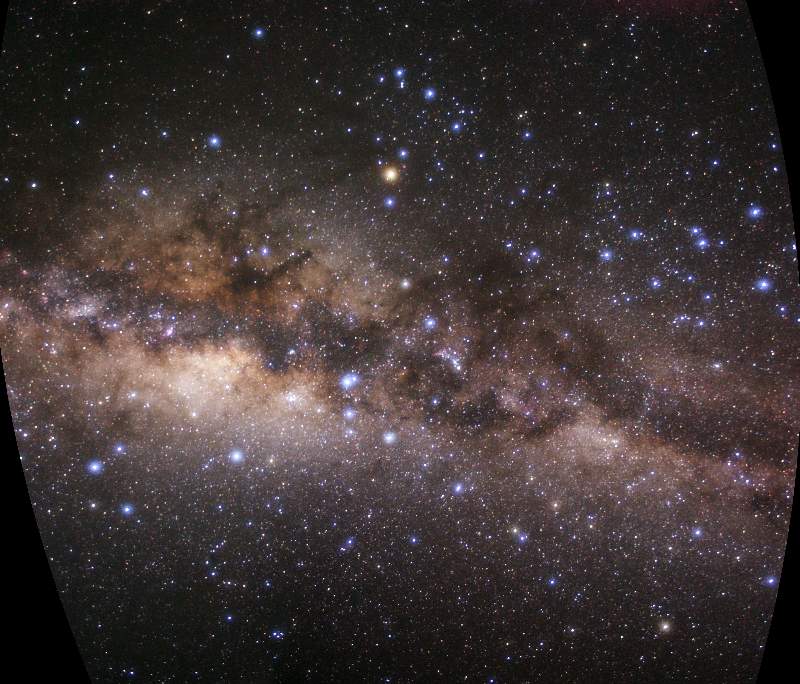
Dark patches (dust lanes) in the Milky Way.  Image from www.southernskyphoto.com.

Prominent in the skies of Australia is the majestic Wedged-tailed Eagle Aquila Audax. Eagles and other Australian Birds feature strongly in many stories told by Indigenous Australians and the Kaurna have an eagle constellation known as Wilto.  Unfortunately, there do not seem to be ethnographical recordings of which particular stars that the constellation of Wilto was comprised. However, I personally believe the Kaurna were referring to the Southern Cross as Wilto. I have a number of reasons for believing this.
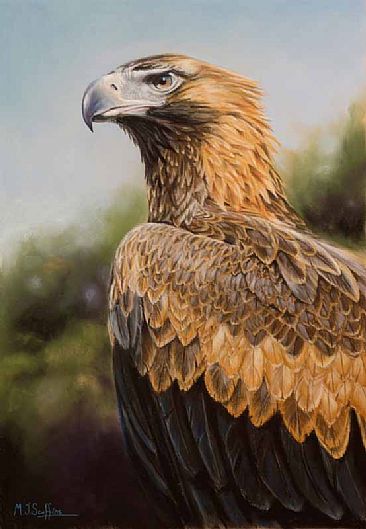
A wedge-tailed eagle.  Image from www.natureartists.com

The Ngadjuri People who lived in the Barossa Valley and Clare Valley region north of the Kaurna People had a constellation they called Wildu. The Ngadjuri People viewed the Southern Cross as the footprint of the Wedge-tailed eagle Wildu.  Furthermore, there are many words that are similar in the Ngadjuri and Kaurna languages in addition to some similar stories. To me, Wildu and Wilto are very similar in sound and they both refer to an eagle. Furthermore, one needs to be mindful that the Aboriginal Peoples of Australia did not use a written language, so many of these names have been recorded by early ethnographers who often spelt the word the way it sounded to them.

Accordingly, as we journey further north through the different Aboriginal Groups in South Australia other peoples also saw the Southern Cross as a Wedge-tailed eagle.  Like the Ngadjuri People, the Adnyamathanha People of the Flinders Ranges also called the Southern Cross Wildu and it was seen as the footprint of the Wedged-tailed Eagle Aquila Audax. In addition, the Aranda People who come from the far north of South Australia and part of the Northern Territory saw the Southern Cross as a Wedgedtailed Eagle that they called Waluwara. The two pointer stars Alpha and Beta Centauri are his throwing stick and the Coalsack Nebula is his nest in the sky. The four brightest stars in the Southern Cross are Waluwaras talons.

The Aboriginal Groups of Australia shared a close relationship with their environment and the natural world for 45,000+ years. Today we are left with just a taste, of the incredibly complex knowledge and understandings that the Kaurna People and other Aboriginal Peoples of Australia have developed over these thousands of years. This early drive to understand the night sky still fires the passions of many contemporary astronomers. Hopefully, efforts will continue to preserve these remaining snippets of stellar knowledge for future generations of Indigenous descendants and night sky enthusiasts.

References

Amery, Rob, 2000, Warrabarna Kaurna: Reclaiming an Australian Language, Swets & Zeitlinger Publishers, Netherlands.

Clarke, Philip, 1990, Adelaide Aboriginal Cosmology, Journal of the Anthropological Society of South Australia, Adelaide.

E.D.S.A., 1989, The Kaurna People: Aboriginal People of the Adelaide Plains, Education Department of South Australia, Adelaide.

Pring, Adele, Warrior, Fred, Knight, Fran, & Anderson, Sue, 2005, Ngadjuri: Aboriginal People of the Mid North Region of South Australia, SASOSE Council Inc.

Pring, Adele, 2002, Astronomy and Australian Indigenous People (draft), DETE, Adelaide. 

Ridpath, Ian, & Tirion, Will, 2000, Collins Guide to the Stars and Planets 3rd EditionCollins, London.

Willis, Roy, 1995, The Hutchinson: Dictionary of World Myth, Helicon & Duncan Baird Publishers, Oxford.

Simpson, Jane, & Hercus, Luise (Editors) et al, 1998, History in Portraits: Biographies of nineteenth century South Australian Aboriginal People, Southwood Press, Sydney.

Wyatt, William, 1879, Some Account of the Manners & Superstitions of the Adelaide & Encounter Bay Aboriginal Tribes with a Vocabulary of their Languages, Names of Persons and Places etc, E.S. Wigg & Son, Adelaide