Wednesday, August 17, 2011

Vacation Scholarships in Aboriginal Astronomy

The Research Centre for Astronomy, Astrophysics, and Astrophotonics at Macquarie University in Sydney is offering up to five vacation (summer) scholarships in related areas of astronomy, including observational astronomy, theoretical astrophysics, astrophotonics, instrumentation, astronomy education, and Aboriginal astronomy. The Centre is part of the Department of Physics & Astronomy, but also includes the School of Education and the Department of Indigenous Studies.

These scholarships are for undergraduate and honours students in Australia that are in their second year of university or higher to research a topic in astronomy.   We have opportunities for students to undertake projects in Aboriginal Astronomy. Indigenous students are encouraged to apply.

Time Duration: 6-7 weeks during January and February 2012

Stipend: $650 per week, tax free (this has recently been increased from $500). Successful applicants outside the Sydney metro area will receive financial support for return travel to Sydney to take up the scholarship.

Eligibility: Must be in 2nd year of undergraduate program or higher. Selection will be based on academic merit and suitability. Students with backgrounds in physics, astronomy, maths, computing, and engineering are preferred, but candidates from other backgrounds will be considered for projects in Aboriginal astronomy (such as the humanities and social sciences).

Deadline: Tuesday, 4 October 2011

Application Form: Click here for PDF. Click here for a Word file. If you are interested in a project in Aboriginal Astronomy, write "Astronomy - Aboriginal Astronomy" in the line provided.

Supporting Documentation:
1) Cover letter
2) Copy of your academic transcript
3) Curriculum Vitae (CV)
4) Contact details
5) References from two academic referees

Terms of Award: Click here for PDF

Selection Process: Click here for PDF

Application Submission Address: Amanda Manypeny, Department of Physics & Astronomy, Macquarie University, NSW, 2109.

E-mail: amanda.manypeney@mq.edu.au

Telephone: 02 9850 4244


Monday, August 8, 2011

Adnyamathanha Night Skies (Part II)

by Paul Curnow (BEd)

...continued from last week.

Our magnificent southern night skies feature two misty white patches known as the Magellanic Clouds. The Magellanic Clouds (below) are two satellite galaxies orbiting our own and the light from these two irregular shaped galaxies can be seen naked eye under dark skies. These misty white patches first came to the attention of Europeans when the Portuguese explorer Ferdinand Magellan recorded them during his journey south in 1519. The Large Magellanic Cloud, which contains around 10,000 million stars, lies approximately 170,000 light years away and the Small Magellanic Cloud lies approximately 230,000 light years away.


As recorded by Tunbridge (1988), the Adnyamathanha call the Magellanic Clouds Vutha Varkla and they are seen as two male lawmen also known as the Vaalnapa.  In Aboriginal society, strict marriage laws are observed and most groups within Australia are divided into two ‘moieties’.  For example, Adnyamathanha society is divided into the Mathari and Arraru moieties. This means that if you are a Mathari person that you are not permitted to marry another Mathari person. Also, if you are an Arraru person you cannot marry another Arraru individual. Therefore, in Adnyamathanha society you must marry someone of the opposite moiety.

Consequently, the Adnyamathanha speak about the two Vaalnapa, or ‘two lawmen’ (below).  These ‘two mates’, the Vaalnapa, had created a fire and are believed to have travelled up into the heavens on the sparks coming from this fire in order to watch over the people and now appear as the two Magellanic Clouds. Furthermore, where some of the sparks from their fire came down to the ground this was an explanation of how gold deposits were formed and where the ashes came to rest on the ground this is believed to have formed lead.


In addition to appearing as the two clouds of Magellan, the lawmen appear as various topographical features in the Flinders Ranges and are also believed to be responsible for the creation of some of these magnificent geographical features. Thus, even to this day, the ‘two lawmen’ still gaze over the Adnyamathana Nation as they have done for aeons assuring that marriage laws are still adhered to.


Interestingly, when missionaries first ventured to the lands of the Adnyamathanha in the hope of converting them to the Christian faith in the 1800’s they told the Adnyamathanha that if they were bad that ‘god’ resided in the sky and that they could be punished. To which the Adnyamathanha would reply, “Yes we know there are two of them,” referring to the two lawmen watching over them.

Additionally, like many early cultures across our vast planet the open star cluster the Pleiades is seen as a group of maidens. As recorded by Mountford (1939), the Pleiades are known to the Adnyamathanha Peoples as the Makara, and are seen a group of marsupial-like women with pouches.  These marsupial women are viewed as a group of ‘ice maidens’ for as the Pleiades make their first appearance before the sun (heliacal rising) and slowly journey across the sky, it is believed that their pouches are filled with ice crystals.

These ice crystals fall from the pouches of the Makara and also stream from their eyes and ears as they travel and the result is the morning frost being spread across the ground. When this takes place the younger members of the group rub these ice crystals on their bodies. It is believed that this will enable the males to grow long beards and become strong, and that the young females will become healthy and fertile. This also coincides with the Wundukara releasing their long beards down from the sky to the surface of the Earth.

The Adnyamathanha also believe that the region is home to the giant serpent Akurra. It is believed that the serpent (or sometimes serpents) formed many of the topographical features of the ranges. For example, it is believed that the Akurra drank all the water from Lake Frome. In fact, the Akurra drank so much water from Lake Frome that his stomach became very swollen and as he crawled up through the creeks he formed all the gullies with his swollen body.


As recorded by Tunbridge (1988), there is another story that relates to the Pleiades. The Pleiades were also known as Artunyi a group of maidens. One of the giant serpents had swallowed up the Artunyi, however, shortly after there came a great flood and the Akurra died. The floodwaters grew higher and higher and slowly reached up to the sky above. The body of the serpent was floating on top of the water and had become swollen as the body decayed. Eventually, the water became so high it nearly touched the sky and the decaying body of the Akurra burst open flinging the Artunyi into the sky where they remain to this day.

To conclude, the boastful hunter in the sky Orion was known as the Miaridtja to the Adnyamathanha. The Miaridtja is a group of men returning to camp after a day’s hunting. The Pleiades set before the stars of Orion and it is believed that the Makara travel below the horizon before the Miaridtja to prepare a fire in order to cook the food that the men will bring back to camp. It is worth noting that the Kaurna who come from the Adelaide Plains of South Australia and the Boorong of north western Victoria also see the stars of Orion as a group of men.

References

Bakich, M. (1995).  The Cambridge Guide to the Constellations, Cambridge University Press.

Cawood, M. & Langford, M. (2000).  The Australian Geographic Glove Box Guide to the Flinders Ranges, Australian Geographic Pty Ltd: Terrey Hills, NSW.


Mountford, C.P. (1939).  Anyamatana Legend of the Pleiades, Victorian Naturalist: Melbourne.

Pring, A. (2002).  Astronomy and Australian Indigenous People (draft), DETE: Adelaide.

Ridpath, I. & Tirion, W. (2000).  Collins Guide to the Stars and Planets 3rd Edition, Collins: Glasgow.

Tunbridge, D. (1988).  Flinders Ranges Dreaming, Aboriginal Studies Press: Canberra.

Warrior, F.; Pring, A.; Knight, F. & Anderson, S. (2005).  Ngadjuri: Aboriginal People of the Mid North Region of South Australia, SASOSE Council Inc: Adelaide. URL


----------

This blog was originally published as Adnyamathanha Night SkiesBulletin of the Astronomical Society of South Australia, June Issue, 2009 , pp. 12-14 by Paul Curnow.
 

Tuesday, August 2, 2011

Adnyamathanha Night Skies (Part I)

by Paul Curnow (BEd)

Aboriginal Australians have been viewing the night skies of Australia for some 45,000 years and possibly much longer. During this time they have been able to develop a complex knowledge of the night sky, the terrestrial environment in addition to seasonal changes. However, few of us in contemporary society have an in-depth knowledge of the nightly waltz of stars above.

Much of the vast wealth of stellar knowledge accumulated by Indigenous Australians over tens of thousands of years, has now sadly been lost to antiquity.  Nevertheless, because of the thoughtfulness of a small number of individuals and the ongoing oral tradition of many Aboriginal Australians, some of this knowledge has been preserved.

Before we venture into the stellar realm of one such group, it must be noted that before the European occupation of Australia began in 1788, there were several hundred distinct Aboriginal languages in Australia.  Accordingly, along with language diversity between groups, other aspects of cultural diversity such as astronomy can vary widely.

The Adnyamathanha Peoples (sometimes spelt Anyamatana) come from the Flinders Ranges region of South Australia (image below). The Flinders Ranges is located approximately 480 kilometres north of Adelaide. These ranges extend for some 420 km and are named after the British explorer Matthew Flinders, who sighted them during his mapping of the Australian coastline in 1802.


The Flinders Ranges is a timeless place of solitude as well as being the site of the incredible Ediacaran Fossil finds and, thus, a geological wonderland.  When the great civilizations of Babylon, Ancient Egypt and classical Rome were flourishing, the Aboriginal Peoples of the Flinders had already lived in, hunted, and roamed the area for thousands of years.  Over time, the various groups who now make up the Adnyamathanha Peoples developed a close relationship with the natural world through their ‘Dreaming’.

The name Adnyamathanha means ‘rock people’ or ‘hill people’, and contemporary Adnyamathanha are made up of a confederacy of the Kuyani, Ngudlawara, Walypi, Yadlhiauda and Barngarla Peoples (sometimes spelt Pangkala).  Much of what we know about their view of the celestial ballet of stars has been passed down through Adnyamathanha Elders the extensive work of Charles Percy Mountford (1890-1976).

Mountford (below) was born in Hallett, South Australia and was an anthropologist who first joined the Anthropological Society of South Australia in 1926, shortly after the passing of his beloved wife in 1925.  He worked with many Aboriginal Cultures in remote areas of Australia during his extensive career.  Furthermore, many agree that Charles Mountford collated an unmatched ethnographic record of the Adnyamathanha Peoples, which included many of their beliefs relating to the nightly movement of stars above.


In the magnificent sky world of the Adnyamathanha there are many ancestral beings.  For example, the Adnyamathanha believe that there are two women in the sky called the Maudlangami (ngami means ‘mother’), whose breasts the spirit children originate from to later become the future children of the group.

Interestingly, this is not the only celestial mammary narrative.  The Ancient Greeks have an account of how the Milky Way came into existence that involves the same pieces of female anatomy.  They believed that the goddess Hera had squirted breast milk across the heavens to create the Milky Way - the name we give our galaxy to this day.

The Adnyamathanha also believe that there are two men in the sky known as the Wundukara, who have long beards that they can release down to the ground. Only a small group of ‘wise men’ in the Adnyamathanha are believed to be able to communicate with and see the Wundukara.  Unfortunately, it was never recorded whether the Wundukara correspond with a visible celestial object or objects.

Continued next week...

Tuesday, July 26, 2011

Yidumduma: A True Aboriginal Astronomer

by Duane Hamacher

This week I want to introduce our readers to Senior Wardaman Custodian and genuine "Aboriginal Astronomer" Bill Yidumduma Harney.  Yidumduma is a world renowned artist, storyteller, writer, songman, musician and the last fully initiated male custodian of the Wardaman people near Katherine, Northern Territory, Australia.


Yidumduma was born between 1932 and 1936 at Brandy Bottle Creek, on Wllleroo Station, Northern Territory and is the son of an Aboriginal mother (Ludi Yibuluyma) and an Irish-Australian father (the famous writer and bushman Bill Harney, although he had little contact with him growing up).  Yidumduma was taught the Aboriginal ways of the Wardaman under the guidance of his Aboriginal step-father, Joe Jormorji, and his mother.  

During an era when Australian governmental policies involved removing mixed-race Aboriginal children from their families and placing them with white families in order to "breed out the colour", known as the Stolen Generations, his sister was sadly taken away.  To prevent young Bill from being taken, his mother covered him in charcoal to hide the whiteness of his skin.  While growing up, Yidumduma spent half the year working on cattle stations and the other half on Walkabout learning the traditional ways.  He underwent the full array of Wardaman ceremonial traditions, education, and initiation.  Today, Yidumduma is in his 70s, speaks seven languages, and is highly active in preserving sites, lecturing around the world, and engaging in education, heritage, and Aboriginal rights.


As a Wardaman custodian, he is responsible for the preservation and knowledge of hundreds of internationally recognized rock art sites, such as the famous Lightning Brothers (see below).  He teaches new generations of Wardaman children the Dreamings and traditions that have been handed down over hundreds of generations through art and oral tradition.


He has actively worked to regain traditional lands and shares Wardaman culture with hundreds of visitors and tourists.  His wealth of knowledge is unparalleled and he has been formally recognised as one of “Australia’s living national treasures”.  The book "Born Under the Paperbark Tree" (written with Jan Wositsky) is an autobiography of his life, and "Dark Sparklers" (with Hugh Cairns) is a full treatise on Wardaman astronomy - being the most complete and detailed work on the astronomy of any Indigenous group in Australia (see below).


In August 2009 he was featured in a two-man 'First Astronomers' show with astrophysicist Ray Norris at the Darwin Festival (below), and in November 2009 he was prominent in the ABC Message Stick program on the Aboriginal Astronomy entitled "Before Galileo".  He also gave the opening for the AIATSIS Symposium on Australian Indigenous Astronomy in Canberra in late November, 2009 (second image below).


We would like to thank Yidumduma for sharing his knowledge and passion with the world.  His knowledge of astronomy is staggering and we have been very fortunate to have worked with such a knowledgeable and enthusiastic man.  To learn more about Wardaman astronomy, order a copy of Dark Sparklers, privately published by Hugh Cairns.


Thanks to Paul Taylor for some of the biographical details.

Tuesday, July 19, 2011

Volcanic Eruptions & Geomythology


This week I want to deviate slightly from our typical posts on astronomy.  As you see in the title, we also cover the field of Geomythology, which is the study of geological phenomena inspiring oral traditions.  The term was coined by Dorothy Vitaliano, a geologist at Indiana University, in 1968.  The word "mythology" is derived from the Greek "mythos", meaning 'story' (or in some cases 'word') and "logos", meaning 'word' in the form of speech.  Thus, mythology can be considered "spoken stories".  There is a long-standing debate regarding the nature and purpose of myth, and associated theories of myth vary significantly between academic disciplines.  We draw from arguments that myths can serve as oral records of natural events and that these records can be elicited by modern science to understand or model historic natural events.  During the twentieth century, the use of myth to explain geological events was viewed with scepticism by the scientific community, as there was little physical evidence to support the hypothesis.  However, in the 21st century, physical evidence is helping geomythology gain new ground as a legitimate discipline and not a fringe science.  The first major peer-reviewed work on geomythology is "Myth and Geology", edited by Piccardi & Masse (Figure 1), which provides the theoretical foundation of the discipline and serves as the methodological basis of our work in geomythology.


Figure 1: The book Myth and Geology, Issue 273 - Special publications of the Geological Society of London

Many oral traditions use natural events or landforms to illustrate a moral point, sometimes including warnings to future generations.  On 26 December 2004, such an example was witnessed by the world as an earthquake off the north-western coast of Sumatra induced a tsunami that swept across the Indian Ocean, killing thousands (Figure 2).  Some indigenous peoples survived the tsunami because of information contained in their oral traditions.  These groups, including the Moken people of Thailand and Indigenous Andaman Islanders, possessed stories that told of great waves that would "eat men" and that these waves would come when the sea rapidly receded.  Their stories told them that to survive they must immediately get to high ground.  Their adherence to these stories saved their lives.  The only group of Indigenous Andaman Islanders that suffered heavy casualties had been converted to Christianity!  This suggests that such events occurred in the past and were significant enough to be incorporated into story lines that lasted long periods of time.  These stories contained information and warnings about natural catastrophes that were crucial to the survival of the community.


Figure 2: The 2004 tsunami in the Indian Ocean.  The Andaman Islands in the vertical island chain between Thailand and India, extending north of Sumatra (the epicenter of the earthquake that triggered the tsunami).  Form the image, you can see these islands were severely hit by the tsunami.  Image credit.

Coastal Australia has been volcanically active in the past, although it is quiet today.  Oral traditions of volcanic eruptions exist from Queensland to Victoria, raising questions about the length of time oral traditions can survive.  I present two accounts here.  The first, and one of the most well-documented examples of geomythology in Australia, are the stories describing the volcanic eruptions that formed the Eacham, Barrine, and Euramo crater lakes in Queensland, which formed more than 10,000 years ago by hot water erupting from the earth (Figure 3).  An Aboriginal elder told a scientist that when the volcanoes erupted, the area was covered in Eucalypt scrub as opposed to the current rainforest.  This was later confirmed by an analysis of fossil pollen found in the silt of these craters, which showed the current rainforest is only 7,600 years old.  Before that, it was Eucalyptus scrub.  The Australian Heritage Commission includes these stories on the Register of the National Estate and within Australia's World Heritage nomination of the wet tropical forests as an "unparalleled human record of events dating back to the Pleistocene era".


Figure 3: Painting by Warren Canendo illustrating the Ngadjonji belief that the sacred serpent Yamani used to travel through underground tunnels that connected the four crater lakes, Lake Eacham (Wiinggina), Lake Barrine (Barany), Lake Euramo (Nuta) and the Mt. Hypipamee Crater (Naypa Naypami).

Similarly, Native American stories describe the eruption of Mount Mazama, which formed Crater Lake in Oregon.  Sandals excavated under Mazama ash have been radiocarbon dated at 6,500 years old, showing the area was inhabited at the time of eruption. Stories from South America suggest Indigenous cultures not only witnessed volcanic eruptions, but that the descriptions of these events remained in the oral tradition for hundreds, perhaps thousands, of years.

The second account is from Victoria and describes an earthquake, volcanic eruptions, a tsunami, and even mega-fauna: 

"The aborigines have a legend which may have had some foundation in reality. They aver that "long ago" a great water (tidal wave) came to Leywhollot (Portland), but as the beach there was too low to restrain it, it rolled on through the Nine-mile forest, devastating the country, and destroying all animal life. It, however, did not reach the summit of Yayah (Mount Eccersly), where some aborigines were then encamped; and they alone of a numerous tribe were left to tell the dismal tale. The legend states that prior to the advent of the wave Wombriknik (Scott's Waterhole) was a great lake; and Wangot (Oak Bank) the haunt of great birds, probably the dinornis. At that time Yallok (Crawford River) was a great arm of the sea; and Banbangil (Mount Vandyke) rose from the plain in one night, and Pyrtpartee (Mount Mistake) leapt up a day or two after. Palawarra (Heywood) was a great swamp, and Benwerrin (Mount Richmond) was on fire. There were great wild beasts in the country then, and at Namburnburn (Ettrick) there were some that the blackfellows dared not encounter. The first blackfellows, the legend asserts, came from where the sun sets, across an isthmus, which the tidal wave destroyed; and when Mount Gambier (Figure 4) begins to burn, and the earth to shake, the tidal wave will come again."


Figure 4: The "Blue Lake", Mount Gambier, South Australia (2004).

The discipline of geomythology is slowly growing.  So far, we've only published a couple of papers on the subject (below), both of which deal with meteorite impacts, although more papers are in queue, including one on aurorae and one on volcanoes.  Stay tuned!

Further Reading

Hamacher, D.W. & Norris, R.P. (2009), Australian Aboriginal Geomythology: eyewitness accounts of cosmic impacts? Archaeoastronomy, Volume 22, pp. 60-93. 

Hamacher, D.W. (2011), Meteoritics and cosmology among the Aboriginal cultures of Central Australia. Journal of Cosmology, Volume 13, pp. 3743-3753. 

Tuesday, July 12, 2011

Djulpan - The Celestial Canoe

The stars that comprise the constellation of Orion are prominent in the astronomical traditions of many Aboriginal communities.  This brief account is from the Yolngu people of Arnhem Land in the Northern Territory.
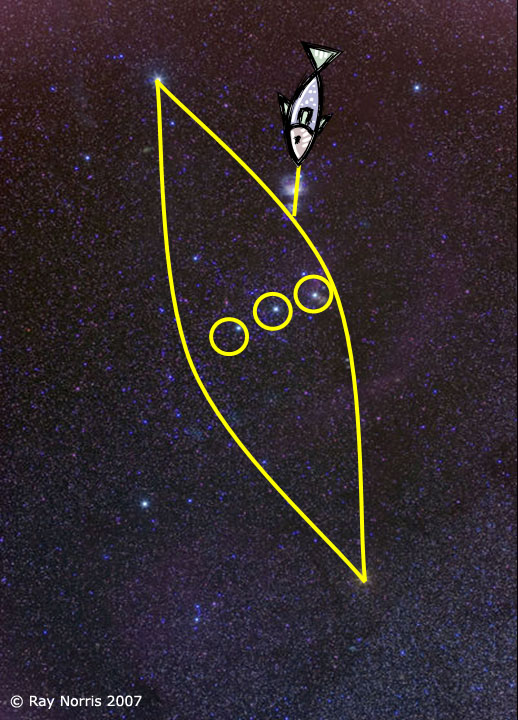
In Figure 1 you can see the stars of orion as visible from Australia.  The line of three stars represent the belt of Orion in classical Greek mythology represent. Above them is the famous Orion nebula, only 1,000 light-years away from us, where new stars are being born.  Greek mythology says this is Orion's sword, which is above his belt because he is standing on his head when seen from Australia!  This asterism is commonly called "the Saucepan" in Australia and New Zealand.  To the bottom right is the red giant star Betelgeuse and bottom left is the blue star Bellatrix, and to the top left is the blue giant star Rigel and top right is blue star Saiph.  These are Orion's hands and feet respectively.


Figure 1: The stars of Orion as seen from the Southern Hemisphere.  The top image shows the common names of the constellation while the bottom image shows the outline of "the saucepan" asterism.  Photo source
A traditional Yolngu story tells how three brothers of the King-fish (Nulkal) clan went fishing, but all they could catch were king-fish.  Because they were in the king-fish clan, traditional lore forbade them to eat these fish, and so they had to throw them back into the water.  Eventually, one of the brothers became so hungry that he decided to break the law, and caught and ate a king-fish. The Sun-woman (Walu) saw this, and was so angry at him for breaking the law that she created a waterspout that lifted them right up into the sky, where you can still see them.  The three brothers are the three stars across the centre of the canoe, and the Orion nebula is the fish trailing on its line in the water (Figure 2).  Thus this constellation is a reminder that you'd better not break the law!

Figure 2: The constellation Djulpan from the astronomical traditions of the Yolngu people of the Northern Territory.
The Kuwema people, near Katherine in the Northern Territory, knew that when Orion rose in the early morning in winter, then the Dingoes would start mating, producing puppies which were an important source of livelihood for the Kuwema people.

We respectfully acknowledge the Yolngu Elders and communities.

Wednesday, July 6, 2011

Astronomy & Rock Art

By Ray Norris and Duane Hamacher


Rock art is found all across Australia, in all states and territories.  Some of it is known to have astronomical symbolism, while other sites are more ambiguous.  Here, we explore the extent to which  astronomical traditions are reflected in Aboriginal rock art. It is instructive to note that in some cases where the traditional Aboriginal culture is largely intact, we have first-hand accounts linking rock-art to astronomy (such as Wardaman elder Bill Yidumduma Harney). However, in some of these cases, such as Figure 1, the astronomical connection would not be apparent to a Western researcher unless guided by cultural knowledge.


Figure 1: Wardaman rock painting of the “Sky Boss” and the Rainbow Serpent. The serpent at the bottom represents the Milky Way, and the head of the Sky Boss is associated with the “Coalsack nebula”, although a researcher could not deduce this astronomical connection without access to the cultural insight of Wardaman elder Bill Yidumduma Harney. (Photo courtesy of Bill Yidumduma Harney).


Other rock art sites in Australia display motifs of astronomical designs, but their meaning has clearly incorporated Western culture. For example, on a hilltop near Palm Valley, Northern Territory is a depiction of the sun, crescent moon, and stars.  However, the Arrernte description of the site has evolved from a traditional view to one that was shaped by Lutheran missionaries that settled the area in the late 19th century. When asked about the purpose of these astronomical engravings, the Arrernte informant explained that they had been placed there by God to direct Jesus while in the desert.  Many features of the landscape had incorporated Christian mythology into the pre-existing oral traditions, including that of a star that was said to have fallen and made a hole between two trees where the Hermannsburg church was later built. Other geographical features of the area served a mnemonic purpose relating the land to Christian events, such as Noah's Flood and the inception of the 10 commandments.

Near Kalumburu, Western Australia is a rock painting on the side of a rock called Comet Rock.  Geologist Ted Bryant suggested that the painting represents a motif of a cometary fragment that impacted the Indian Ocean causing a great tsunami that swept over the land, which he claims is supported by Aboriginal stories. The rock is 5 km from the ocean on a plain covered in a layer of beach sand (Figure 2).  A similar example is a Dreaming story that describes a cosmic impact, followed by a deluge, in the Darling Riverbed near Wilcannia, NSW. According to Jones, rock art on Mt Grenfell showing people standing on one another’s shoulders may represent people climbing the mountain to escape the flood. In addition, certain star-like motifs can be found engraved in rock in the Sydney-Hawkesbury region, although their meaning is unknown. These designs typically involve a small circle with lines radiating outward, suggesting a sun, star, or "sunburst" motif.


Figure 2: Comet Rock, which Ted Bryant speculates is a representation of a comet that impacted the Indian Ocean, causing a massive tsunami.

The Sun and Moon in Aboriginal Rock Art

In most Aboriginal cultures, the Moon is male and the Sun is female. For example, a Yolngu oral tradition explains the motion of the Sun in terms of Walu, the Sun-woman. She lights a small fire each morning, producing the dawn, and decorates herself with red ochre, some of which spills onto the clouds, to create the red sunrise. Carrying a blazing torch made from a stringy-bark tree, she travels across the sky from east to west, creating daylight. At the western horizon, she extinguishes her torch, and travels back underground to her morning camp in the east.  An ethnographer was told "the Sun goes clear around the world" by a Yolngu man who illustrated this "by putting his hand over a box and under it and around again."

The Yolngu people call the Moon-man Ngalindi. The phases of the Moon are caused by Ngalindi being attacked by his wives, who chopped bits off him with their axes, reducing him from the fat full moon to the thin waning Moon, and eventually dying (the new Moon).  After staying dead for three days, he rose again, once more growing round and fat to become the full Moon, when his wives attacked him again.

Yolngu culture also recognises that the tides are caused by the Moon, and that the height of the tides depends on the phases of the Moon. This is explained in terms of a complicated interaction between the rising Moon and the Sea, the Moon alternately filling and emptying, depending on its phase, as it rises through the ocean horizon. While it is dangerous to generalise from one Aboriginal culture (Yolngu) to others, there exist similarities that transcend Aboriginal cultures, such as the gender of the Sun and Moon, which are almost universally female and male respectively.

Given these strong oral traditions, we might expect to find depictions of the Sun and Moon in Aboriginal rock art.  Obvious examples of solar images exist, such as those at Ngaut Ngaut, South Australia (Figure 3) and many more are surmised, such as the "bicycle wheel" or "sunburst" petroglyphs in the Panaramittee engravings at Sturts Meadows, NSW (Figure 4). However, the latter can entertain many interpretations, including a supernova, and caution is required when interpreting such images in the absence of cultural context.


Figure 3: The Sun engraving at Ngaut Ngaut, South Australia.


Figure 4: A “bicycle-wheel” or “sunburst” petroglyph at Sturts Meadows, NSW. While this may represent the sun, or perhaps even a supernova, there is no additional information to support these interpretations, and so any interpretation remains speculative.


Crescent shapes are also common, and may represent the moon, although they have also been attributed to boomerangs.  Many examples of crescent shapes are found in the Sydney Basin rock engravings, and are traditionally referred to as boomerangs (such as Fredrick McCarthy). However, there is a clear difference between a boomerang-shape and a crescent moon: boomerangs typically have straight sides and rounded ends, whereas the crescent moon always has a curved shape and pointed ends (Figure 5). It is therefore likely that the Sydney Rock Engravings contain a significant astronomical component.


Figure 5: A crescent-shaped rock engraving from Calga Springs, NSW; the crescent Moon, and a Boomerang. Note the smooth curve and pointed ends of the engraving, as opposed to the relatively straight lines and rounded ends of the boomerang.


Eclipses

Several Aboriginal cultures recognised that eclipses are caused by a conjunction of the Sun and Moon. For example, in Arnhem Land a solar eclipse is caused by the Sun-woman being hidden by the Moon-man as they make love, while a lunar eclipse is caused when the Moon-man is pursued and caught by the Sun-woman.  Similarly, Daisy Bates reported that the solar eclipse of 1922 was said by the Wirangu people to be caused by the Sun and Moon "becoming husband and wife together".

These stories demonstrate a significant intellectual accomplishment. To understand a solar eclipse, in which the Moon comes between the Earth and the Sun, is impressive, but perhaps not surprising if traditional Aboriginal thinkers carefully studied the motion of the Sun and Moon. However, to understand a lunar eclipse, in which the Earth’s shadow extinguishes the Moon, requires a significant leap of understanding, since it occurs when the Sun and Moon are diametrically opposed in the sky, and it is precisely this alignment that causes the eclipse.

Amongst the crescent motifs found in the Sydney Rock Engravings are several examples that depict a man and woman under, or next to, a crescent shape. In the case of the Basin Track engraving (Figure 6), the sign erected by the National Parks and Wildlife Service explains that the engraving shows a man and woman with a boomerang. However, it is unclear why a man and woman should reach up towards a boomerang in the sky. The engraving makes more sense if, as suggested above, the crescent represents a Moon rather than a boomerang, but is still unusual in that the moon is shown with the two horns pointing down, a configuration normally seen only when the moon is barely visible in the early morning or late afternoon. But such a configuration can be seen during an eclipse, and this suggestion is supported by the two figures, one of which partially obscures the other. Such carefully drawn obscuration is unusual in these rock carvings, and in this case may represent the Moon-man obscuring the Sun-woman (or vice-versa) during an eclipse. Other circumstantial evidence for this hypothesis is that the man and woman face toward the northeastern horizon, in the direction a solar eclipse could be seen in the early morning. For example, such an eclipse, with the horns pointing downwards as depicted, took place on the morning of 8 August 1831.  John Clegg speculated that a hermaphrodite figure near this engraving may represent the moon-man and sun-woman fully superimposed during a total eclipse.


Figure 6: The “eclipse” engraving at the Basin Track, Ku-ring-gai Chase National Park, NSW.


The Emu in the Sky

Across the zenith of an Australian Autumn sky stretches the bright band of the Milky Way. Within it can be seen a number of dark patches and streaks, caused by clouds of interstellar dust in which new stars are being born. Perhaps the best-known Aboriginal constellation is the "Emu in the Sky", formed not of stars, but of the dark patches between them. Amongst the Sydney Rock Engravings, close to the Elvina Track, is a finely engraved emu (Figure 7), carefully drawn to show the gizzard and other anatomical features. On the other hand, its legs trail behind it, in a position that would be unnatural for a real emu, but is very similar to that of the Emu in the Sky. This was first noted by Hugh Cairns, who suggested the engraving might represent the Emu in the Sky rather than a real emu. This suggestion is further supported by the fact that the time of the year when the Emu in the Sky stands in the evening above her portrait, in the correct orientation, is the same time when real-life emus are laying their eggs. It seems quite possible that this engraving is a picture of the Emu in the Sky rather than a real emu.


Figure 7: The “Emu in the Sky”, consisting of dark patches in the Milky Way, above the Emu engraving at Elvina track, Ku-ring-gai Chase National Park, NSW. Photo by Barnaby Norris (2007).


Astronomical Records

Figure 3 shows one of the engravings of the Sun and Moon at Ngaut Ngaut, providing clear evidence of an astronomical connection at this site. Close to this engraving are carved a series of dots and lines (Figure 8), which, according to the traditional Nganguraku owners, show the "cycles of the Moon". This oral tradition has been passed through generations from father to son, but since initiation ceremonies were banned (along with the Nganguraku language) by Christian missionaries over a hundred years ago, only this fragment of knowledge survives, and it is not known exactly what the symbols mean. Certainly the dots and lines resemble tally marks, and the site’s astronomical connection suggests that they may indeed represent astronomical records. However, we have so far failed to decode them. We plan to conduct further tests to search for evidence of astronomical periodicities in the marks.
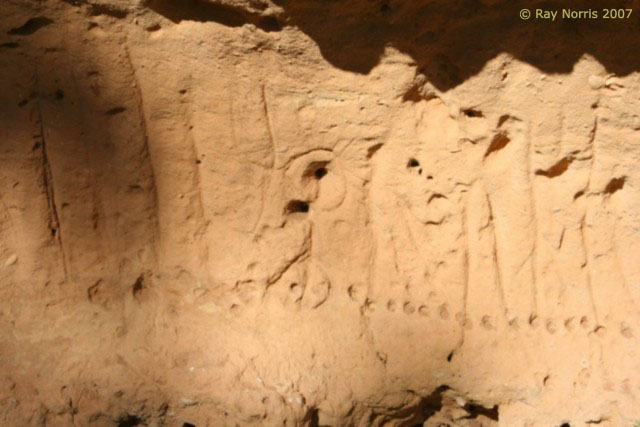

Figure 8: The Ngaut Ngaut rock art site near the banks of the Murray River north of Adelaide, South Australia.


Read more here: Norris, R.P & Hamacher, D.W. (2011). Astronomical symbolism in Australian Aboriginal rock art.  Rock Art Research, Volume 28, Issue 1, pp. 99-106.