Professor Steven Tingay, Curtin University, Perth

Saturday, October 26, 2013


Sunday, October 20, 2013
Aurorae in Australian Aboriginal Traditions
The Aurora Australis is seen by many Aboriginal groups as an omen of bushfires in the spirit world, according to a new study of traditional Indigenous oral culture.
The research found most traditional teachings associated the reddish hues of the Aurora Australis or southern lights, with blood, fire and death.
"That's very different from the more festive stories associated with the Aurora Borealis or northern lights, in the traditional cultures of Canada, Siberia and Northern Europe, says the paper's author Dr Duane Hamacher of the University of New South Wales.
 |
| Aurorae Australis over the oceans south of Victoria, Australia. Image by Alex Cherney http://www.terrastro.com/wp-content/gallery/aurora-australis/aurora22jan2012_nex5.jpg |
Read the rest of the story here.
Read the published paper here.
TEDx NorthernSydneyInstitute: Look Up! There's an Emu in the Sky
Dr Duane Hamacher, University of New South Wales, Sydney
Monday, September 23, 2013
Australian Space Sciences Conference
The Australian Space Sciences Conference is having their annual meeting at the University of New South Wales this year from 30 September to 2 October 2013.
On Wednesday, 2 October, the ASSC will feature a plenary talk and a dedicated session to Indigenous Sky Knowledge. The papers presented at the meeting will be combined and published as a free eBook early next year.
Talks include:
Plenary Talk (9:00-9:30 am)
John Goldsmith: The "Ilgarijiri- Things Belonging to the Sky" project: Collaboration between
Aboriginal communities and radio astronomy in Australia.
ISK Session (10:30-11:00 am)
Les Bursill: Acknowledgement of Country and Welcome
Hugh Cairns: An Ancient Aboriginal Astronomy from the Northern Territory
Trevor Leaman: Ooldea Nights: Daisy Bates and the Aboriginal Sky Knowledge of the Great
Victoria Desert, South Australia
Robert Fuller: The Sky Knowledge of the Kamilaroi People and Their Neighbours
David Pross: Sky Knowledge and Rock Art in the Sydney Basin
Duane Hamacher: Are Supernovae Recorded in the Astronomical Traditions of Aboriginal
Australians?
Geoff Wyatt: Star wheel and signals: Sydney Observatory's Shared Sky
education program
Alice Gorman: Beyond the Morning Star: the Voyager spacecraft and Australian Aboriginal
culture
Ragbir Bhathal: Perspectives on Aboriginal Sky Knowledge
A full program can be viewed here.
On Wednesday, 2 October, the ASSC will feature a plenary talk and a dedicated session to Indigenous Sky Knowledge. The papers presented at the meeting will be combined and published as a free eBook early next year.
Talks include:
Plenary Talk (9:00-9:30 am)
John Goldsmith: The "Ilgarijiri- Things Belonging to the Sky" project: Collaboration between
Aboriginal communities and radio astronomy in Australia.
ISK Session (10:30-11:00 am)
Les Bursill: Acknowledgement of Country and Welcome
Hugh Cairns: An Ancient Aboriginal Astronomy from the Northern Territory
Trevor Leaman: Ooldea Nights: Daisy Bates and the Aboriginal Sky Knowledge of the Great
Victoria Desert, South Australia
Robert Fuller: The Sky Knowledge of the Kamilaroi People and Their Neighbours
David Pross: Sky Knowledge and Rock Art in the Sydney Basin
Duane Hamacher: Are Supernovae Recorded in the Astronomical Traditions of Aboriginal
Australians?
Geoff Wyatt: Star wheel and signals: Sydney Observatory's Shared Sky
education program
Alice Gorman: Beyond the Morning Star: the Voyager spacecraft and Australian Aboriginal
culture
Ragbir Bhathal: Perspectives on Aboriginal Sky Knowledge
A full program can be viewed here.
Thursday, July 11, 2013
A Shark in the Stars: Astronomy and Culture in the Torres Strait
Originally published in The Conversation, 10 July 2013, 6.36 am EST
 |
| Tagai by Glen Mackie |
Technology has, without doubt, expanded our understanding of space. The Voyager 1 space probe is on the brink of leaving our solar system. Massive telescopes have discovered blasts of fast radio bursts from 10 billion light years away. And after a decade on Mars, a Rover recently found evidence for an early ocean on the Red Planet.
But with every new advance, it’s also important to remember the science of astronomy has existed for thousands of years and forms a vital part of Indigenous Australian culture, even today. As an example, lets explore the astronomy of the Torres Strait Islanders, an Indigenous Australian people living between the tip of Cape York and Papua New Guinea.
Sunday, July 7, 2013
Stories Under Tagai: Traditional Stories from the Torres Strait
Presented at the 2012 MyLanguage Conference held at the State Library of Queensland in August. It tells the story of the Indigenous Knowledge Centres' (IKC) of the Torres Strait and explores the work in gathering and retelling community stories. Produced by the State Library of Queensland.
Wednesday, July 3, 2013
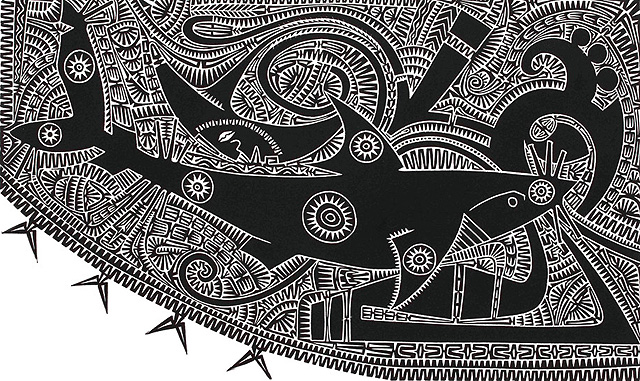
Baidam – The Shark Constellation
 |
| Baidam painting by Dennis Nona. |
In the astronomical traditions of Torres Strait Islanders, Baidam is a shark. The shark constellation consists of seven stars. The stars of Baidam were used for navigation and provided knowledge about the seasons and for
gardening fruit and vegetables. In about July/August Baidam will level itself across the horizon of New Guinea [to the north]. At seven or eight o'clock
you will see it parallel to New Guinea. At this time the wind drops. Around
this time we begin planting vegetables and fruit: Cassava, Dawai
(banana), Guru (sugar cane), Taro/Urrgubau (sweet potato). Those are the main ones
planted when the shark lies across the horizon. When it becomes calm in the
Torres Strait, around this time, a grease forms on the surface of the sea. I
have shown this in the artwork. The grease is called "Baidam aw
id" - "when the shark liver has melted on the sea". At this time
it is also shark mating season: a dangerous time in the sea. The shark
constellation rotates throughout the year. In February, when you see the stars
beginning to shine, that's the shark. (Account by Dennis Nona)
 |
| Baidam artwork by Brian Robinson. |
Editor's note: Some of the accounts identify the seven stars in question as the Seven Sisters (the Pleiades). This seven stars of Baidam are actually the seven bright stars of the "Big Dipper" (the brightest stars of the Western constellation Ursa Major - the Big Bear). From the Torres Strait, these stars appear low on the horizon to the north and coincide precisely with the description above. Because the Pleiades are commonly associated with seven stars, they are sometimes conflated with Baidam. It doesn't help that when scaled to the same size, the Pleiades and the Big Dipper look very similar! (See below.) In Torres Strait traditions, the Pleiades star cluster is called Usiam. - Duane Hamacher
Pleiades Big Dipper


Subscribe to:
Posts (Atom)