Wednesday, February 29, 2012

Sydney City Skywatchers - Lecture on Aboriginal Astronomy


Join the oldest operating astronomical group in Sydney. The group provides an opportunity for those interested in astronomy to share and broaden their interest in the sky. People at all levels are catered for from beginners to serious amateur astronomers. Whether you want to just listen to a monthly lecture or to discuss serious observing through a telescope, this is the club for you.

These meetings usually consist of brief reports of observations made during the month by club members and a presentation from a guest speaker followed by a light supper. There is a $2 fee for each meeting.

by Duane Hamacher
Monday, March 5th at 6:30 pm - Sydney Observatory

Aboriginal Australians had a complex astronomical knowledge system that may stretch back for over 50,000 years. This knowledge extended beyond having names and stories for celestial objects. It included a deep intellectual component that was used for navigation, time keeping, food economics, and social structure.

Recent research from the Aboriginal Astronomy Project at Macquarie University has revealed a wealth of astronomical knowledge and practices by Aboriginal people, including the construction of stone arrangements and ceremonial sites to cardinal directions and astronomical objects, such as the setting position of the sun or the orientation of the Milky Way. Aboriginal people paid careful attention to, and had explanations for, eclipses, comets, meteors, and variable stars. Research also suggests that oral traditions describing meteorite impact events remain strong after thousands of years.


In this talk, Duane Hamacher from the Aboriginal Astronomy Project will discuss the latest results from the Project and explore how Aboriginal Australians may very well be the world’s oldest astronomers.

Duane Hamacher giving a tour of Aboriginal rock art sites, including the famous Emu in the Sky engraving, 
in Kuring-gai Chase National Park north of Sydney.

About the Speaker

Duane Hamacher is a trained astronomer and science educator at Macquarie University and Sydney Observatory. After graduating in physics from the University of Missouri and completing a Master's degree in astrophysics at the University of New South Wales, he submitted a PhD thesis at Macquarie University where he researched the astronomical knowledge and traditions of Aboriginal Australians. He is currently the Jenni Chandler Fellow in Aboriginal Astronomy in the Department of Indigenous Studies and manages the Association for Astronomy at Macquarie.

Talks are followed by supper ($2 donation)

Open to Members and everyone who is passionate about astronomy.  It is possible to join Sydney City Skywatchers on the evening or take home a membership form.

Bookings are not required.

Thursday, February 23, 2012

Karrugang and the Origin of the Pleiades


This is a Gundungurra story from the Blue Mountains (NSW) about 
the origin of the star cluster Westerners call the Pleiades.

In the Dreaming, a group of sisters were pursued by a magpie named Karrugang, who wanted to make one of the sisters his wife.  One day, while digging for edible roots near a river, one of the sisters slipped into the river and became tangled in the weeds, drowning.  The magpie saved the woman and made her his wife.  The other sisters stayed at the camp with the crow and his wife.  The magpie was lazy and made all the women do the work.  The women frequently tried to escape, but the magpie would find and return them to his camp.  One day during a storm, the wife pulled stringy-bark from a tree to make a shelter whilst her sisters sang a charm song.  As the lazy magpie lay around, the sisters sang making the tree grow taller and taller.  They quickly climbed the bark into the sky where they are seen today as the sisters of the Pleiades.

A Magpie.  From true-wildlife.blogspot.com

Reference
Mathews, R.H. (2003).  Some mythology and folklore of the Gundungurra tribe.  Den Fenella Press, Wentworth Falls, NSW.

Wednesday, February 8, 2012

Ngaut Ngaut - A Lunar Calendar?

From Paul Curnow and Ray Norris (edited by Duane Hamacher)


On the banks of the Murray River, north of Adelaide, is a rock art site called "Ngaut Ngaut" that has astronomical connections.  However, those connections are shrouded in mystery.  The Traditional Owners know that some of the engravings represent the sun and moon, but the banning of their language and oral traditions by Christian missionaries over 100 years ago resulted in knowledge about this site being lost.


An Aboriginal guide named Cess explaining the fossils and rock art of Ngaut Ngaut
to the Supernova Group (from Adelaide Planetarium) in 2003.

Ngaut Ngaut is part of the Ngarrindjeri Nation, which encompasses the region stretching along the Coorong in South Australia to along the Murray River to Blanchetown further north.  The Traditional Custodians of Ngaut Ngaut are the Nganguraku (sometimes spelt Nganguruku), who form part of the Ngarrindjeri Nation.


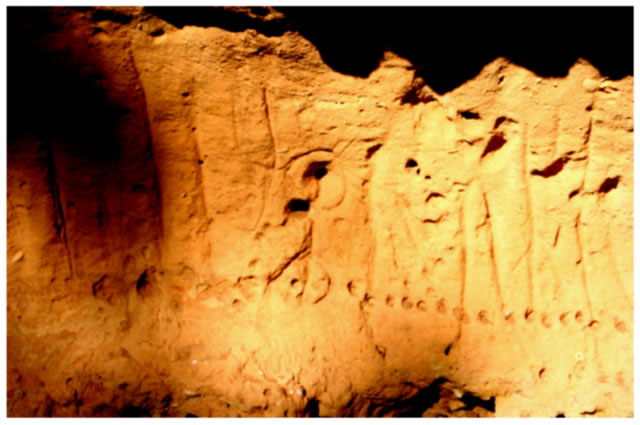
Ngaut Ngaut was the site of Australia’s first archaeological excavation in 1927.  Dating evidence taken from the remains of ancient campfires suggests that humans have occupied this area as long ago as 27,000 years.  The site includes various engravings, or petroglyphs, of animals, people, deities, the sun and moon.  Close to the engravings are a series of dots and lines carved in the rock, which, according to the Traditional Owners, show the "cycles of the Moon". 

Engraving of the sun.  Image by Paul Curnow.
Lunar cycle tally marks at Ngaut Ngaut?  Image by Ray Norris.

This oral tradition has been passed through generations from father to son, but since initiation ceremonies were banned (along with the Nganguraku language) by Christian missionaries over a hundred years ago, only this fragment of knowledge survives, and it is not known exactly what the symbols mean.  Are they tally's of each full moon?  In parts of central New South Wales, Aboriginal men cut notches into sticks at each full moon so as to keep track of their age, so this idea is certainly plausible.  But what are the verticle lines above the dots?  What is the strange symbol in the middle?  Why are dots superimposed on the sun engraving?

The rich record engraved on the walls of Ngaut Ngaut has so far defied attempts at decoding it, but we are setting our sites on unlocking the astronomical secret, which will be the focus of future research.

-------------

Take a guided tour of Ngaut Ngaut here.

Friday, January 27, 2012

The Origin of the Moon


This is a Dreaming story from Cape York in far northern Queensland.

Many years ago, people realised that a light was needed at nighttime because they found it difficult to walk around or to hunt. The Sun lit up their daytime - something was needed to light up the night.

They held a big meeting and one idea was to collect a huge pile of firewood during the daytime hours and setting fire to it just as the Sun set. People thought that the fire would be big enough to light up the bush so that they could hunt and walk around and have corrobores. Most of the people thought that this idea was impractical.

One member of the tribe had great idea: why not make a special boomerang that would shine, throw it high in to the sky and at night this boomerang would give enough light to allow people and animals to see at night.

They made a giant boomerang. People tried to throw it high into the sky. They tried but they just couldn't throw it high enough.

Then, a very thin, old, weak man stepped forward and politely asked if he could try. Everyone laughed at him when they saw his weak, thin arms. One of the elders was a kind and wise man and he said the old man should be allowed to throw the boomerang.

And throw the boomerang the old man did! It went higher and higher and higher and finally stayed up in the sky as the Moon, shining down onto the people.

The shape of the boomerang can still be seen in the Moon every month.

Original Source: Questacon.

Sunday, January 22, 2012

Astronomical Symbolism in Australian Flags

By Duane Hamacher

Australia has three official flags: the national flag, the Aboriginal flag, and the Torres Strait Islander flag.  Everyone knows about the astronomical symbolism of the national flag: it features the smallest of all 88 constellations: Crux - otherwise known as the Southern Cross.

The national flag of Australia.

The four 7-pointed stars to the right are the five brightest stars in the constellation Crux: Alpha Crucis (Acrux), Beta Crucis (Mimosa), Gamma Crucis (Gacrux), and Delta Crucis.  The small 5-pointed star represents the fainter star Epsilon Crucis.

While some have thought the large, 7-pointed star below the Union Jack represents Beta Centauri - the right of the Pointer stars (the left being Alpha Centauri) - this is not the case.  The large star is the Commonwealth Star, also called the Federation Star, representing the Federation of Australia which came into force on the first day of 1901.

But did you know the Aboriginal and Torres Strait Islander flags also contain astronomical symbolism?

The Aboriginal flag of Australia is split into a black region on top, a red region on bottom, with a yellow disk superimposed in the centre.  It was designed by Harold Thomas, a descendent of the Luritja people of Central Australia, in 1971.

The Aboriginal flag of Australia.

The colour black represents the Aboriginal people, the colour red represents the red earth and the red ochre (which has a spiritual link to the land), and the yellow disc represents the sun - the protector and giver of life.

The Torres Strait Islander flag comprises green panels at the top and bottom with a blue panel in the centre.  Between the green and blue panels are thin black lines.  Superimposed in the centre is a white dhari (headdress) and a white 5-pointed star.  It was designed by Bernard Namok, from Thursday Island, in 1992 to represent the unity and identity of Torres Strait Islander people.  It was recognised as an official Flag of Australia on 14 July 1995.

The Torres Strait Islander Flag.

The colour green represents the land, the colour blue represents the ocean, and the colour black represents the Torres Strait Islander people  - showing their close connection to the land and sea.  The white dhari is a headdress worn by dancers and the 5-points of the white star represent the five major island groups of the Torres Strait.  It also represents a star for navigation, which was very important to the sea-faring people of the Torres Strait.  The colour white represents peace.

----------------

We respectfully acknowledge Aboriginal and Torres Strait Islander Elders and extend our respects to Harold Thomas and Bernard Namok, the designers of the Aboriginal and Torres Strait Islander flags, respectively.

Tuesday, January 17, 2012

Tagai - A warrior from the Torres Strait

One day Tagai and his crew of Zugubals (beings who took on human form when they visited Earth) were fishing from their outrigger canoe. They caught no fish, and so Tagai, the leader and the best fisherman of all, left the canoe and walked onto the nearby reef to look for fish there. He was gone for a long time.
While waiting for him the crew grew hotter and hotter — they dived into the sea but even that didn't cool them off. Only by drinking water would they be cooled, but the only water in the canoe belonged to Tagai, who had carefully stored it in coconut shells which he had hung over the side.
How the men longed for water!
As they grew hotter and thirstier they decided they could wait no longer. They hauled the coconut shells up into the canoe and drank the deliciously cold water.
When Tagai returned he was furious that all of the drinking water for their voyage had gone. In his fury he killed all twelve of his crew.
Because they were Zugubals, he returned them to the sky and placed them in two groups, Usal (the Pleiades) and Utimal (Orion). He told his crew to stay in the northern sky and to keep away from him.
Now when the crew wish to appear in the eastern sky, they must signal their coming by causing thunder and lightning, and Tagai, hearing this, dips below the western horizon.
The people of the Torres Strait look up to Tagai and from his position in the night sky know when the seasonal rains will come and when they should plant crops. When Tagai's left hand (the Southern Cross) dives towards the sea the first rain of the season, Kuki, will begin.

Source: Questacon.

Wednesday, January 11, 2012

Graven Images - A Novel

This week I want to bring something a little different to your attention.  Professor Ray Norris, the director of the Aboriginal Astronomy Project, has written and published a novel entitled Graven Images.

After just a few short months, Graven Images climbed to the Amazon top 100,000 Best Seller list!

-----------------------


2005 - the year of the London tube bombings. Within the gentle ranks of the Pagan movement lurks a sinister group that uses scaremongering and terrorism to restore witchcraft as Britain’s primary religion. A young Cambridge biologist, Owen, penetrates their cabal while seeking to avenge the death of his archaeologist girlfriend, whom he believes was killed to halt her research into Bronze-Age stone circles. Owen dismisses beliefs in Wicca and witchcraft as superstition, but applies his scientific reasoning to decode ancient legends, and discovers a secret that will transform modern religion. After being drawn into a terrorist plot, he finds himself sliding helplessly from respected academic to hunted criminal, out of his depth in lies and intrigue.

Graven Images draws connections between the byways of historical fact, University politics, and contemporary culture. It's a provocative adventure whose nail-biting tension is lightened by moments of comedy, leaving you wondering how much of this is really fiction.


-----------------------

This is the first novel from Ray Norris.  Ray is an astrophysicist at the CSIRO whose day-job is to find out how the Universe evolved from the Big Bang to the present day.  He also researches Australian Aboriginal astronomy and the astronomy of British Bronze-age stone circles.


To research this novel, Ray learnt from modern-day Wiccans, connecting their beliefs to his knowledge of ancient astronomy, encapsulated in the stone circles and megaliths of Britain.  An atheist himself, but fascinated by other people's beliefs, he was amazed to find how this ancient pagan religion is still deeply but secretly engrained across the strata of modern British society.


As well as over 250 professional publications, Ray frequently appears on radio and TV and performs in a stage show called "The First Astronomers". For relaxation, he walks the moors of Dartmoor and the Australian bush, and writes.

Click here for a preview of Graven Images.

Click here to purchase the novel or download it for Kindle.

Learn more about Ray, the Novel, and the science behind the story at the Graven Images Homepage.

------------------


Reviews of Graven Images

"It's a beautiful plot, and I loved the main character, Owen... sigh... Its one of those rare books that sometimes gets you on the edge of your seat, sometimes leaves you teary, and other times moments of humor which make you laugh out loud."


"Brilliant book! I got totally caught up in it and couldn’t put it down. It really keeps you on the edge of your seat. Also it has a lot about Wicca and the Museum in it.  What I really liked was the stuff about the links between Wicca and very early British paganism - it gets you wondering! Can’t say more or I'll spoil it for you if you haven’t read it! Totally recommend it for Wiccans and non-Wiccans."

"I got completely immersed into the plot of this story. The characters are so authentic (I am a scientist myself) and the story is so well defined that I could not stop reading! Great mixture of science, history, religions, traditions, and most of all, the deepest human emotions. A "must read" fully recommended."

"Norris combines historical facts, his experiences as an academic, and the summers he spent surveying stone circles across Britain to write an engrossing, emotive story about the life-changing events of a young academic and his emotional quest for revenge and justice. Graven Images is a fantastic read with a great story-line, well-developed characters, and a few surprising twists. Highly recommended!"